
Ask questions about your evidence. Get answers in seconds. See everything in context.
Legal teams have always faced the same fundamental challenge: you have a pile of documents, and you need to understand who did what, with whom, and when. ChronoTracer was built to solve that problem to give you a clear, chronological view of the events in your case.
Today, we’re taking a major step forward. We’ve redesigned the ChronoTracer interface and introduced agentic AI capabilities that let you interact with your evidence in a completely new way.
Start with a complete picture
Before we talk about AI, it’s important to understand what’s underneath it.
When your documents are loaded into ChronoTracer, they’re processed through a rule-based, deterministic pipeline. This isn’t an AI reading your documents and deciding what looks “important” it’s purpose-built code that restructures your evidence into a normalized database, with every event tagged by date and time, event type, participants, and source. You get a comprehensive, sequential list of every event found in your documents traceable back to its source, and produced the same way every time. And this works quickly and efficiently at scale ChronoTracer has processed cases with tens of millions of documents and events.
When you’re dealing with evidence, you need to trust the foundation. A rule-based pipeline gives you that confidence in a way that AI extraction can’t nothing is fabricated, nothing is interpreted, and the results are yours to verify.
That event list is your starting point. What’s new is what you can do with it.
Ask questions. Get answers.
ChronoTracer’s new agentic AI sits on top of your event list and lets you ask questions in plain language the same way you’d ask that colleague on your team who has read every document in the case, spent months organizing the evidence, and has terrific recall. Every litigation team knows that person, and knows how indispensable they are. That’s what ChronoTracer’s AI gives you instant access to that level of familiarity with your evidence. You can still use keyword searches, Boolean queries, and manual filters the same way you always have. But now the AI can handle that complexity for you translating a plain-language question into the right combination of searches and filters behind the scenes.
Here’s what that looks like in practice:
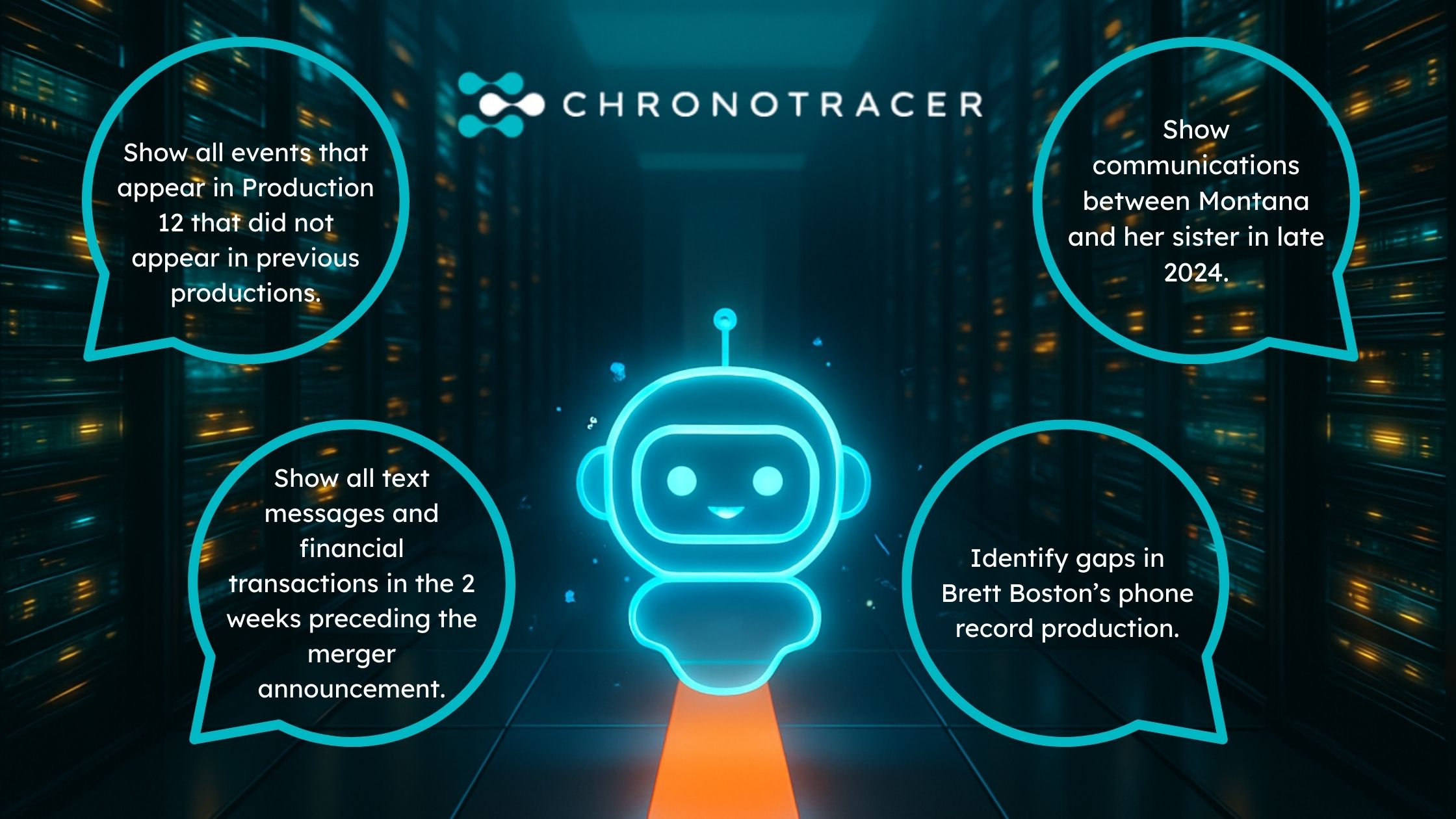
- “Show communications between Montana and her sister in late 2024.”
- “Identify gaps in Brett Boston’s phone record production.”
- “Show all text messages and financial transactions in the 2 weeks preceding the merger announcement.”
- “Show events involving board members within 24 hours after the Fall 2023 board meeting.”
- “Show all events that appear in Production 12 that did not appear in previous productions.”
- “Show all Bloomberg terminal messages and text messages between employees of Dawnridge Capital and employees of Hargrove Linden.”
- “Show all evidence about the January 2 meeting.”
Some of these are straightforward filters. Others require the AI to reason through multiple steps identifying a production set and comparing it to previous ones, or finding a specific event and then looking at a time window around it. That’s what makes it agentic: it can break down a complex question into the steps needed to answer it, then use a variety of internal tools to get you there.
AI and manual filters, working together
The agentic AI doesn’t replace ChronoTracer’s existing filter tools. It works alongside them. You can start an inquiry with the chatbot, use the manual filters to narrow further by event type, by participant, by date range and then go back to the chatbot with a follow-up question on your filtered set. The AI and the manual tools are complementary. For teams with established filter workflows, the AI doesn’t disrupt those it extends them.
Why structure matters
If you’ve been following AI in legal tech, you’ve seen the wave of tools that use retrieval-augmented generation RAG to let you “chat with your documents.” An AI chunks your documents, retrieves fragments it thinks are relevant, and generates a response.
Today, the most visible problem with that approach is hallucination sometimes those generated answers are wrong. A well-known Stanford study found significant hallucination rates in leading legal AI tools, and while the technology has improved since then, the fundamental risk remains: any time an AI is generating text from document fragments, there’s a chance it gets something wrong. ChronoTracer avoids this entirely because our AI is querying a structured database of real events, not generating new text.
But even as AI models improve and hallucination rates decline and they will the structural advantages of ChronoTracer’s approach remain. A structured database of events is faster than running an AI over raw documents every time you have a question. It’s more precise every event has a date, participants, an event type, and a source citation, which means you can filter, sort, and cross-reference with exactness that generated text can’t match. And it gives you the actual evidence in sequence, in context, traceable to its source. Not a summary. Not an excerpt. The events themselves, in chronological order, ready for you to work with.
That’s the foundation ChronoTracer is built on, and it’s why we believe this architecture will continue to outperform approaches that start with AI and work backward to structure.
AI and identity resolution, working together
Every case has people and devices (such as phone numbers, email addresses, bank accounts, and social media handles) that need to be associated with the right individuals. Once they are, you can see a person’s complete activity across your evidence, even if they’re switching between email, Slack messages, WhatsApp, Venmo, and Instagram. Without that association, you’re looking at fragments scattered across channels. It’s tedious work to get right, and getting it wrong muddies everything downstream.
ChronoTracer’s new integrated identities layer makes it easier to organize the actors in your case, so your chronological view is cleaner and more accurate from the start. And the agentic AI is designed to work across all of it. It isn’t tied to a particular view or tab. It lives across the entire application, so you can ask questions about your events, explore identity relationships, and move between different parts of ChronoTracer without losing your thread.
The two capabilities reinforce each other. Cleaner identity data means more accurate answers from the AI. And the AI makes it easier to spot connections you might otherwise miss, like a key participant communicating from a personal email address, or the same person appearing under a nickname or maiden name across different channels.
See it at LegalWeek
To learn more, read the press release here. And we’re showing off these capabilities at LegalWeek 2026, starting March 9. If you’d like to see ChronoTracer in action with your own eyes, come find us at booth 605 or schedule a demo and we’ll walk you through it.