
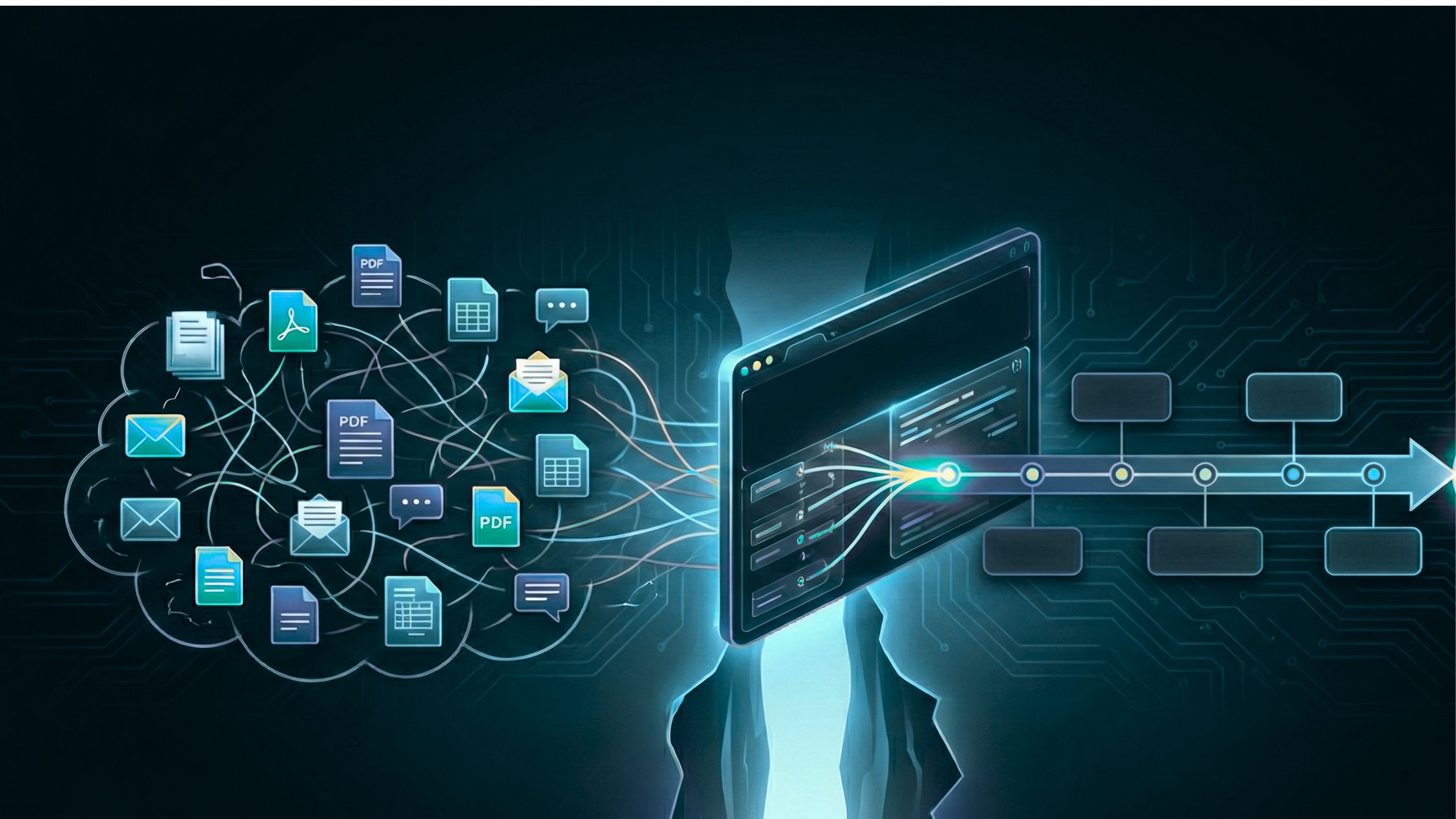
We’ve often described ChronoTracer as “e-discovery adjacent.” That’s true in the market, and it will be literally true at Legalweek.
At the North Javits Center, you’ll find our booth near platforms like Relativity, DISCO, and Reveal, among others. We’re neighbors on the show floor because we’re neighbors in legal teams’ toolchains.
We don’t replace e-discovery systems. We sit alongside them.
Those platforms are excellent at what they were built to do: document review. But document review is not the same thing as understanding what happened.
They are built around documents. ChronoTracer is built around time – understanding what happened, in order.
That distinction — document-by-document versus event-by-event — changes how quickly and completely a team can understand what actually happened.
Where the Gap Appears
The gap doesn’t show up during production. It shows up when lawyers start asking questions.
In modern matters, a single phone bill can contain thousands of communications across different dates and times. A Slack export may capture months of conversations. Video conference logs record meetings and participants. A financial ledger reflects a sequence of transactions over time.
Each may be produced as a document.
But lawyers (and other humans) don’t think in documents.
They think in events.
When you shift from document-by-document to event-by-event, the structure changes.
That structure is useful long before a deposition and long after.
It informs early case assessment. It shapes case theory. It supports internal investigations. It sharpens deposition outlines. It anchors hearing preparation. And at trial, it becomes the backbone of how you present what happened.
Document review organizes files.
Event-level structure organizes the story.
In a document-centric workflow, those answers have to be assembled. Who spoke to whom? When? How often? What changed after that meeting? And what happened immediately before and after?
You search. You code. You export. You reconcile duplicates. You check time zones. You cross-reference threads.
When records are treated primarily as documents rather than structured events, the narrative has to be built by hand. That manual assembly is where the time goes. And it’s where important connections are often missed — whether the matter involves thousands of documents or millions.
Five Things That Are Hard in E-Discovery and Simple in ChronoTracer
1. Extracting What Happened from the Documents, Automatically
In most e-discovery platforms, a 1,000-page phone record remains one reviewable document. In ChronoTracer, that same file becomes thousands of individual, time-stamped call and text events, structured, normalized, and immediately filterable. Instead of reviewing a document to extract what happened, you start with what happened.
No tagging. No dragging. No spreadsheet.
2. Understanding the Record from Day One
Review platforms provide searchable text immediately. ChronoTracer provides a structured, ordered event stream. As soon as ingestion is complete, you can search and filter across participants, date ranges, and event types without first building a manual timeline. You are not waiting for weeks of coding and structuring to begin asking factual questions. The structure exists from the start.
3. Bringing Disconnected Evidence into One View
Modern matters rarely live in one system.
ChronoTracer interweaves time-based records across sources into a single ordered view:
- Emails
- Texts and chat messages
- Phone logs
- Financial transactions
- Social media activity
- Media files
They appear together in one stream.
You are not toggling between document types to reconstruct context. You see how events unfolded across systems, the way they happened in real life.
4. Making Sense of Identities Across Devices and Accounts
Large matters rarely involve clean, single identities. Review platforms display metadata fields. ChronoTracer provides case-specific identity management: a way to associate phone numbers, email addresses, handles, and aliases with the people in your case.
As understanding evolves, identities can be reconciled and refined without rebuilding the underlying record. In complex matters involving multiple devices or overlapping productions, that consistency becomes critical.
5. Answering New Questions Without Starting Over
In a traditional document-centric workflow, new factual questions often require new searches, new coding, or new exports. In an event-centric system, you pivot filters. Change the participants. Adjust the timeframe. Narrow to a specific event type.
Seconds later, you are looking at a different factual lens on the same underlying record.
ChronoTracer makes these workflows native, event-level, and fast, designed so litigation teams can use it with minimal training and without building complex review workflows first.
Built to Sit Alongside Your Platform
We are not trying to displace your review platform. We are trying to reduce the manual work that happens after ingestion and before strategy solidifies.
E-discovery systems excel at review, defensibility, and production — at any scale. ChronoTracer excels at structuring time-based evidence into an ordered record of what happened, whether you are working with a focused production or a multi-source record containing millions of documents.
The future is not either/or. It is document management plus event-level structure.
ChronoTracer does not replace your system. It gives you a clearer, faster way to see what happened – across everything – in order.